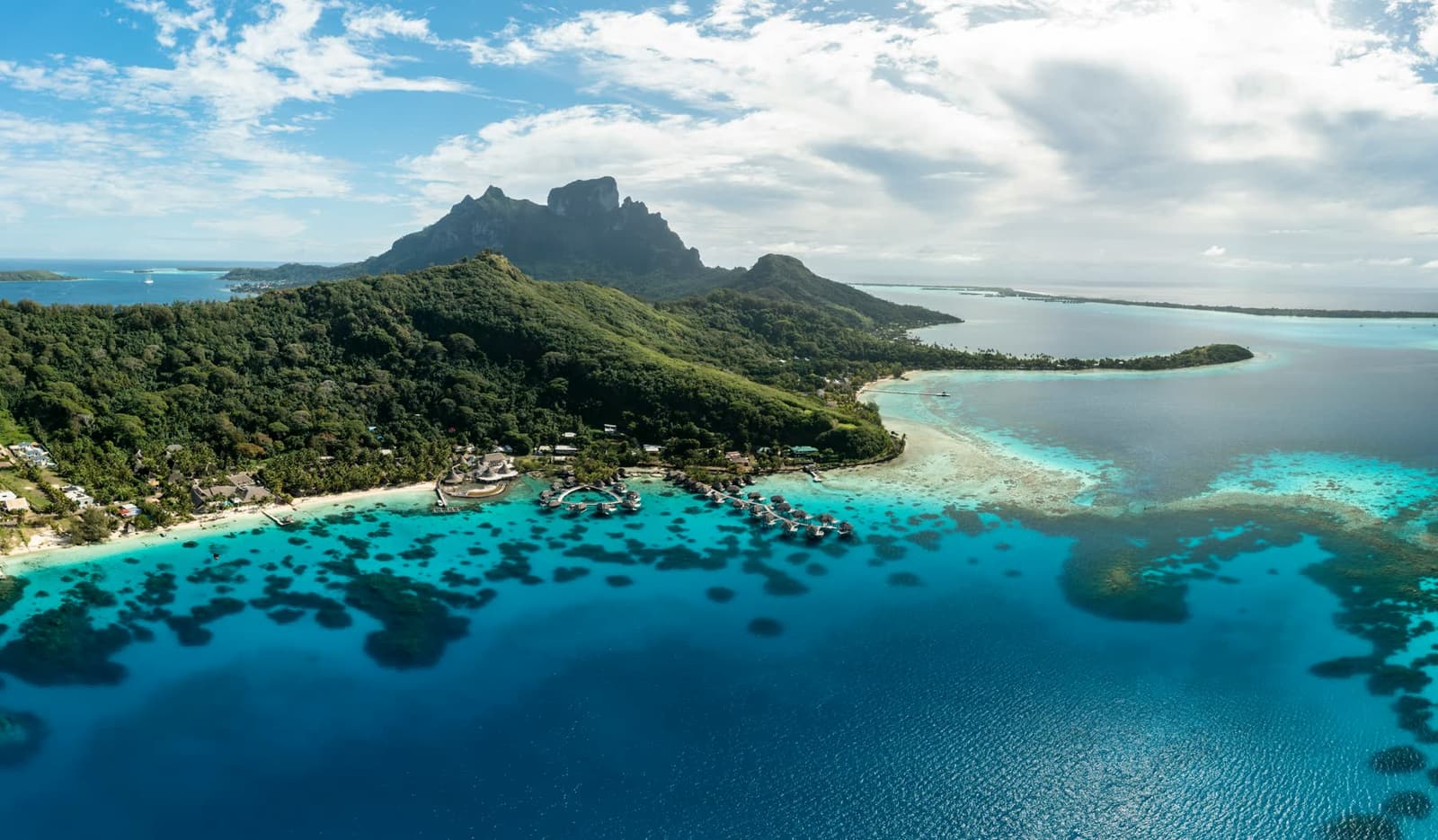

French Polynesia yacht charter
French Polynesia is 118 islands: the high, green Society Islands with lagoons inside their reefs, and the Tuamotu atolls with their passes. The drier months, May to October, are the pick. It suits honeymooners and divers.
French Polynesia is 118 islands spread over a vast area of the South Pacific. The Society Islands are high and green, with lagoons inside their reefs: Tahiti, Moorea, Huahine, Raiatea, Taha'a and Bora Bora. The Tuamotus are atolls, low rings of coral around lagoons, famous for their passes. The Marquesas are far to the north-east, steep and wild. A yacht is the best way to see more than one island here, because the hotels are each on a single one.
Why go, and whom it suits
Couples and honeymoons
This is the most obvious fit. Bora Bora's lagoon, Taha'a's vanilla farms and nights at anchor inside a reef make it one of the classic honeymoon voyages.
Families
The lagoons are calm and shallow, there are rays and reef sharks to snorkel with, and the islands are safe and easy. The flights are long, so it suits older children best.
Friends and celebrations
It suits a group that dives, kitesurfs or simply wants to swim all day. The passes of the Tuamotus draw divers from all over the world.
Less suited to anyone who wants nightlife or busy towns. Papeete is the only city. Elsewhere, an evening out is a small restaurant on the shore.
The areas
French Polynesia is the eastern end of our South Pacific and Australasia. It has three island groups.
The Society Islands
(page to follow). Tahiti and Moorea are close together. Huahine, Raiatea, Taha'a and Bora Bora, the Leeward Islands, lie a long passage to the north-west. Raiatea and Taha'a share one lagoon. Taputapuātea, on Raiatea, is a UNESCO-listed marae, an ancient ceremonial site.
The Tuamotus
(page to follow). Rangiroa and Fakarava are known for their passes, where divers meet sharks, manta rays and dolphins; Fakarava is a UNESCO biosphere reserve. They lie a long passage north-east of Tahiti.
The Marquesas
(page to follow). High islands without lagoons, about 1,500 km north-east of Tahiti. They are usually visited by expedition-style yachts on longer voyages.
When to go
- The drier season runs from about May to October. It is cooler, with steadier trade winds.
- The wet season runs from about November to April. It is hotter and more humid, with tropical showers, most of all from December to February. These are also the months of the South Pacific's tropical cyclone season, from November to April.
- For most people the drier months are the pick.
Months | Weather | Note |
|---|---|---|
May to October | The drier season: cooler, with steadier trade winds | The pick for most people |
November | The wet season begins: hotter and more humid | The South Pacific's cyclone season runs from November to April |
December to February | The wettest months, with tropical showers | Cyclone season |
March and April | The wet season, hotter and more humid | Cyclone season |
What it costs
The charter fee is each yacht's own weekly rate. Her page shows it "from", which is her lowest season. Each yacht's rate is in its own currency, often US dollars outside Europe. Our guide sets out what a crewed charter costs, line by line.
- Tax is added where it applies, under French Polynesia's own tax rules. Ask us how it applies to the yacht you are considering.
- APA, the Advance Provisioning Allowance, is paid with the balance. It is money held by the captain for fuel, food, drinks, moorings and similar costs, spent on your instructions and accounted for at the end; anything unspent is returned. Budget up to 40% of the charter fee; the long passages between island groups can need more.
- Delivery. A start away from where the yacht is based can add a delivery fee (fuel, crew, berths), stated before you sign.

The weekly rate on each yacht’s page. "From" is her lowest season.
An advance for fuel, food, drinks and berths, spent on your instructions and settled at the end.
Set by the country the charter starts in, added to the fee.
Tahiti to Bora Bora
This is a one-way week through the Society Islands. It ends at Bora Bora, a 50-minute flight from Tahiti. The yacht and the trade wind decide the real order.
Board in Papeete and cross to Moorea, a short crossing. Anchor in Opunohu Bay below the mountains.
Snorkel with rays and reef sharks in the lagoon at Tiahura, as the crew shows you. Walk up to the Belvédère lookout over Opunohu Bay.
A longer passage, often overnight. Huahine is the quietest of the Society Islands.
The marae at Taputapuātea. Then inside the lagoon to Taha'a.
The vanilla farms and pearl farms, and the coral garden between two motu, which you drift through with a mask on.
Through the only pass into the lagoon, and a day on the motu, the islets round its edge.
A last swim and disembarkation, to Bora Bora's airport.
The yachts that cruise here
The yachts we show in French Polynesia are mostly motor yachts over 40 metres, for 11 or more guests. Many cruise the Pacific for a season, and several also appear on our pages for Fiji and the other Pacific islands. We arrange crewed yachts here and look across the market for each enquiry, among the yachts based in Tahiti and those passing through. The yachts on this site are a selection, not the limit of what we arrange: ask about any yacht, of any size.
Practical questions


Rene GaspersicYour broker
How do we get there?
Fly to Papeete, on Tahiti. International flights from Paris, Los Angeles, San Francisco, Seattle, Honolulu, Tokyo, Auckland and Rarotonga land at Tahiti-Faa'a International Airport. Most people spend a night on Tahiti before boarding.
Can we see the Tuamotus and the Society Islands in one week?
It is a stretch, because the passage between them is long. A two-week charter works better, or a domestic flight to join the yacht in the Tuamotus: Rangiroa is about an hour's flight from Tahiti, and Fakarava about 1 hour 10 minutes.
Is the sea rough?
Inside the lagoons, rarely. Between the islands you are on the open Pacific, and the trade wind and swell are felt on the passages.
Are there sharks?
Yes. Snorkelling with reef sharks and rays is one of Moorea's lagoon outings, and divers in the passes of the Tuamotus meet grey sharks. The crew knows where it is safe to swim.
Do we need a visa?
Citizens of France and the EU need no visa, and many other nationalities are exempt for tourist stays of under three months. Check the rules for your passport before you travel.
Is it suitable for a honeymoon?
It is one of the classic choices. Tell us the dates. The yacht, the route and the start are planned around the flights.
Is French Polynesia expensive?
Yes, ashore and in provisioning. Budget up to 40% of the charter fee for the APA; the long passages between island groups can need more.
What about the Marquesas?
They are for a longer voyage, often on an expedition-style yacht. Tell us, and we look for a yacht that goes there.
If you are also weighing Fiji
Fiji has shorter distances, a long dry season and village visits. French Polynesia has the lagoons and the passes. Both are long flights. See Fiji.
Talk to a broker
Tell us roughly when, how many of you there are, and what the trip is for: a honeymoon, a family voyage, a dive trip with friends. Dates and budget can stay loose. We come back with a short list of yachts that fit, say plainly what each one is like, and stay your contact from the first email to the last day on board.
Rene Gaspersic
charter broker
Email info@soretoyachting.com · Phone +44 7342 933198 · WhatsApp +44 7342 933198
Plan
French Polynesia.
Two short steps. Dates and budget can stay loose. We reply personally, by email, phone or WhatsApp.